
The Cats Nobody Counts: Why Big Cat Conservation Begins Outside Protected Areas
Tigers and lions attract headlines and funding. But the survival of the world's big cats depends on a quieter, harder fight playing out in wetlands, mountain passes and unprotected land where the formal conservation system barely reaches.
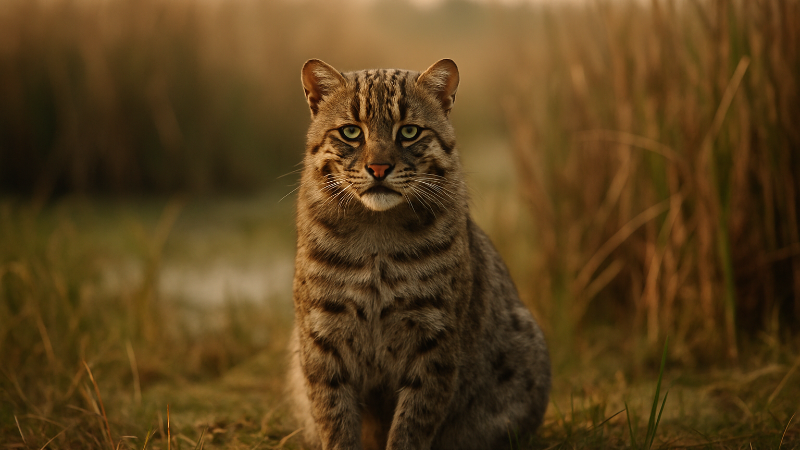
Thirty-one kilometres from the centre of Kolkata, where the city's density finally gives way to reed beds and shallow ponds, lives a wild cat that most people in West Bengal have never seen. The fishing cat, the state's official animal, is classified as high conservation priority by the IUCN. It hunts at night, moves between private farmland and unprotected marshes, and exists almost entirely outside the perimeter of formal wildlife protection. Its survival depends not on national park boundaries but on whether the farmers who share its territory decide to tolerate it.
This is the central problem in big cat conservation that rarely makes it into the mainstream account of the field. The global narrative has long organized itself around flagship species in designated reserves: tigers in Ranthambore, snow leopards in high-altitude sanctuaries, lions in the Serengeti. These places are real, and the work done in them matters. But a significant portion of the world's wild cat population lives beyond those boundaries, in agricultural margins, wetland edges and human-dominated landscapes where formal protection is thin and enforcement is inconsistent at best.
In southern West Bengal, the fishing cat's situation makes that gap visible. Much of its core habitat in the Howrah and Hooghly districts sits on private and community-owned land. The Wildlife Protection Act exists in theory; in practice, a forest officer covering that ground must contend with the reality that a cat killed in a private marsh falls into a legal grey zone that nobody moves quickly to prosecute. Roadkill has become the single largest recorded cause of fishing cat mortality in the region. Not poaching, not direct persecution, but infrastructure spreading across habitat that was never formally designated as habitat at all.
The problem is compounded by perception. Locally, the fishing cat is known as the Baghrol, a name that translates roughly as tiger-cat. That association, intended as a mark of respect, has instead created a persistent myth that the animal poses a serious threat to fishermen's catches. Villagers who have never seen one in the wild, the cat is intensely shy and nocturnal, hold fears shaped by second-hand accounts rather than direct observation. Some have killed cats they mistook for leopards. The prejudice is not malicious; it is a product of genuine unfamiliarity with an animal that does its living after dark and vanishes into tall waterweeds when disturbed.
The same dynamic, at a different altitude and with a different cast, plays out across the Himalayas. Snow leopards at over 4,000 metres in places like Kibber, in the Spiti Valley, occupy a cold desert landscape where domestic livestock herds outnumber wild prey. When a snow leopard breaks into a corral and kills animals, the financial and emotional toll on a subsistence farming family can be severe. The instinct to retaliate is understandable. The challenge for conservation is to make tolerance economically rational before that instinct takes hold.
What both situations share is the same structural reality: the most critical front in big cat conservation is not inside protected areas, where the formal system has at least some presence. It is in the unprotected, human-occupied landscape surrounding them, where the infrastructure of protection is almost entirely absent and where the attitudes of individual farmers, herders and village communities determine whether these animals survive from one generation to the next.
The conservation organizations working in these spaces know this. The question is whether the broader field, and the funding that flows through it, is organized to support it.
Join the Ecoflix community and watch Fishing Cat: The Pride of Bengal at https://watch.ecoflix.com/programs/fishing-cat-the-pride-of-bengal
First published in the Ecoflix newsroom.
More in Conservation

Why Nature Is Now a Climate Strategy
This week marks World Environment Day 2026, themed Inspired by Nature. Behind the slogan is a growing body of evidence that restored ecosystems are among the most powerful climate tools available — and some of the least used.
Read feature
What 35,000 Square Kilometres Can Teach Us
In the 1990s, China's Loess Plateau was the most eroded place on Earth. What happened next is one of the most documented and significant acts of ecological recovery ever recorded — and its lessons apply far beyond China's borders.
Read feature
The Activists Holding Ocean Destroyers to Account
From Grenada's reefs to the killing bays of the Faroe Islands, the front line of ocean protection is held by a small number of organizations willing to go where others do not. What they find there is both troubling and clarifying.
Read feature