
Saving Spider Monkeys Means Reconnecting Forests
In Costa Rica’s Osa Peninsula, the survival of spider monkeys depends on more than protected forest alone. Their future increasingly rests on whether fragmented rainforest can be stitched back together before roads, monoculture and illegal

The canopy of Costa Rica’s Osa Peninsula still holds one of the richest concentrations of life anywhere on Earth. In a relatively small stretch of rainforest, an extraordinary density of species continues to survive in vertical layers of leaves, vines and fruiting trees that remain ecologically connected in ways many tropical forests no longer are. Yet even here, where more than two per cent of global biodiversity is concentrated, continuity is becoming the central conservation question.
For animals that rarely descend to the forest floor, continuity is not a detail of habitat design but the basic condition of survival. Spider monkeys move through the upper forest like specialists built by evolution for aerial travel, relying on long limbs and fully prehensile tails to cross gaps, forage widely and maintain social contact between family groups. A break in that canopy, whether caused by logging, a new road or agricultural clearance, is not simply an interruption in scenery. It can become an ecological barrier that changes feeding patterns, breeding routes and vulnerability to predators.
That pressure sits quietly beneath Kalu – Growing Up Wild, where the early life of a young Geoffroy’s spider monkey unfolds through what appears at first to be a familiar story of growth: learning balance, social rank and food selection inside a tight family group. Yet beneath those intimate moments is a larger environmental truth. Every movement Kalu makes depends on a forest structure that remains physically connected enough to support an arboreal life.
Young spider monkeys spend their earliest months almost entirely dependent on their mothers, but independence arrives quickly and awkwardly. In canopy species, the first successful movement away from maternal contact is more than behavioural development. It is an early test of the forest itself. Branch spacing, fruit availability and nearby cover all determine how safely juveniles learn movement.
The Osa Peninsula still offers those conditions in many areas because large tracts of old forest remain intact. Fruit-bearing trees draw not only spider monkeys but capuchins, coatis and birds into temporary feeding assemblies that keep nutrients and seeds moving through the system. What falls from the canopy feeds mammals below. What is eaten is dispersed elsewhere. Forest regeneration begins in these ordinary feeding events.
Spider monkeys occupy a particularly important place in that process because they consume and transport seeds over considerable distances. Their feeding routes effectively shape future forest composition. Certain large-seeded tropical trees depend heavily on mammals capable of carrying fruit far enough from parent trees to avoid overcrowding and disease pressure. When spider monkey numbers decline, forest structure changes gradually, then measurably.
This makes primate conservation inseparable from forest regeneration. The loss of a single species does not stop at species count. It alters which trees recruit, how quickly gaps recover and which parts of forest become less resilient under climate stress.
That is why fragmentation has become such a serious concern across Central America. A narrow road can divide canopy routes that took centuries to establish. Even where forest appears extensive from above, breaks of only a few metres can prevent safe movement for young animals or isolate feeding groups that once travelled across broader territories.
In Kalu, one moment captures this with unusual clarity: a forced leap between trees during conflict with capuchins. For adult spider monkeys, canopy jumps are routine, though never without risk. For juveniles, they can determine whether separation from the group becomes injury, exposure or predation. The scene works because it reflects a daily biological calculation repeated across fragmented tropical forests everywhere: whether the next branch is reachable.
Where forest has already been divided by agriculture, that calculation becomes harsher. Oil palm plantations, cattle pasture and other simplified land uses remove vertical complexity almost entirely. To human eyes they remain green. To arboreal wildlife they are ecological dead space.
The distinction matters because monoculture landscapes often border protected areas, creating sharp transitions between high biodiversity and near biological silence. Species adapted to layered forest cannot simply adapt sideways into uniform crops. They lose shelter, feeding diversity and escape routes at once.
Illegal hunting compounds that pressure. Spider monkeys reproduce slowly, with long maternal investment and relatively few offspring over a lifetime. Populations do not recover quickly after losses. Removing even a small number of adults can destabilise group knowledge, feeding routes and juvenile survival for years.
The most practical answer now under active discussion in tropical conservation is not only larger reserves but better connections between existing ones. Wildlife corridors, especially canopy-linked corridors, allow primates to move between feeding grounds, maintain gene flow and respond more flexibly to seasonal shifts in fruiting.
In Costa Rica, corridor design increasingly includes mixed-use land where reforestation meets farming rather than excluding people entirely. That matters because conservation success in densely used landscapes depends on local participation. Smallholder tree planting, riparian restoration and agroforestry often produce more durable results than isolated protection lines on maps.
For spider monkeys, even narrow strips of connected tree cover can reopen routes that disappeared within a generation.
Climate change adds urgency to this work. Fruit timing in tropical forests is already shifting in some regions, altering where primates must travel and when food shortages occur. Species that can move adapt better. Species trapped inside shrinking fragments face repeated nutritional stress.
The wider lesson from Kalu is that rainforest conservation is no longer only about preserving what remains untouched. It is increasingly about repairing what has already been divided before those divisions become permanent ecological decisions.
The future of canopy wildlife may depend less on spectacular new reserves than on modest acts of reconnection: a restored river edge, a replanted boundary, a road crossing designed for movement above ground rather than below it.
For a young spider monkey learning how far he can trust the next branch, those choices are not abstract policy. They are the physical shape of the world he will inherit.
Click Here To Watch Kalu – Growing Up Wild
External Links
International Union for Conservation of Nature (IUCN) – Geoffroy’s spider monkey
Smithsonian Tropical Research Institute
First published in the Ecoflix newsroom.
More in Wildlife

What Happens When the Lights Come On at Sea
Seabirds are declining faster than almost any other bird group on the planet. The reasons are varied, the solutions less so — and a single night rescue operation on Madeira shows exactly how much ground we have already lost, and how little it takes to stop losing more.
Read feature
What Two Women in Kibber Taught the World About Living with Snow Leopards
At more than 4,000 metres in the Spiti Valley, Dolma and Chodon have helped turn a village of leopard-wary herders into a community that now reports seeing more snow leopards than it did twenty years ago. The model behind that change is worth understanding in full.
Read feature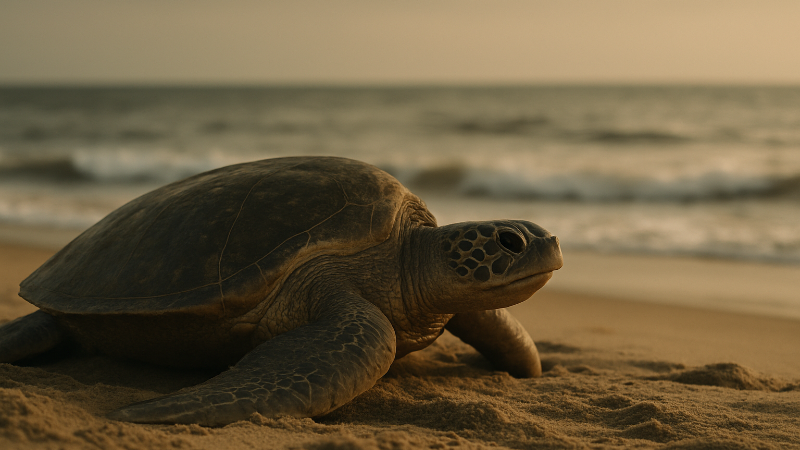
Why Sea Turtles Are Still Losing Ground
Sea turtles have outlasted mass extinctions, ice ages and the rise of every modern predator. What they have not yet outlasted is the ocean as it exists today — and World Turtle Day is a sharp reminder of what hangs in the balance.
Read feature