
Collision: the invisible toll of ships on the great whales
Every year thousands of great whales are struck and killed by ships, and we see fewer than one in twenty. Collision, premiering on Ecoflix, follows the scientists, sailors and shipping companies proving this is a problem we already know how to solve.
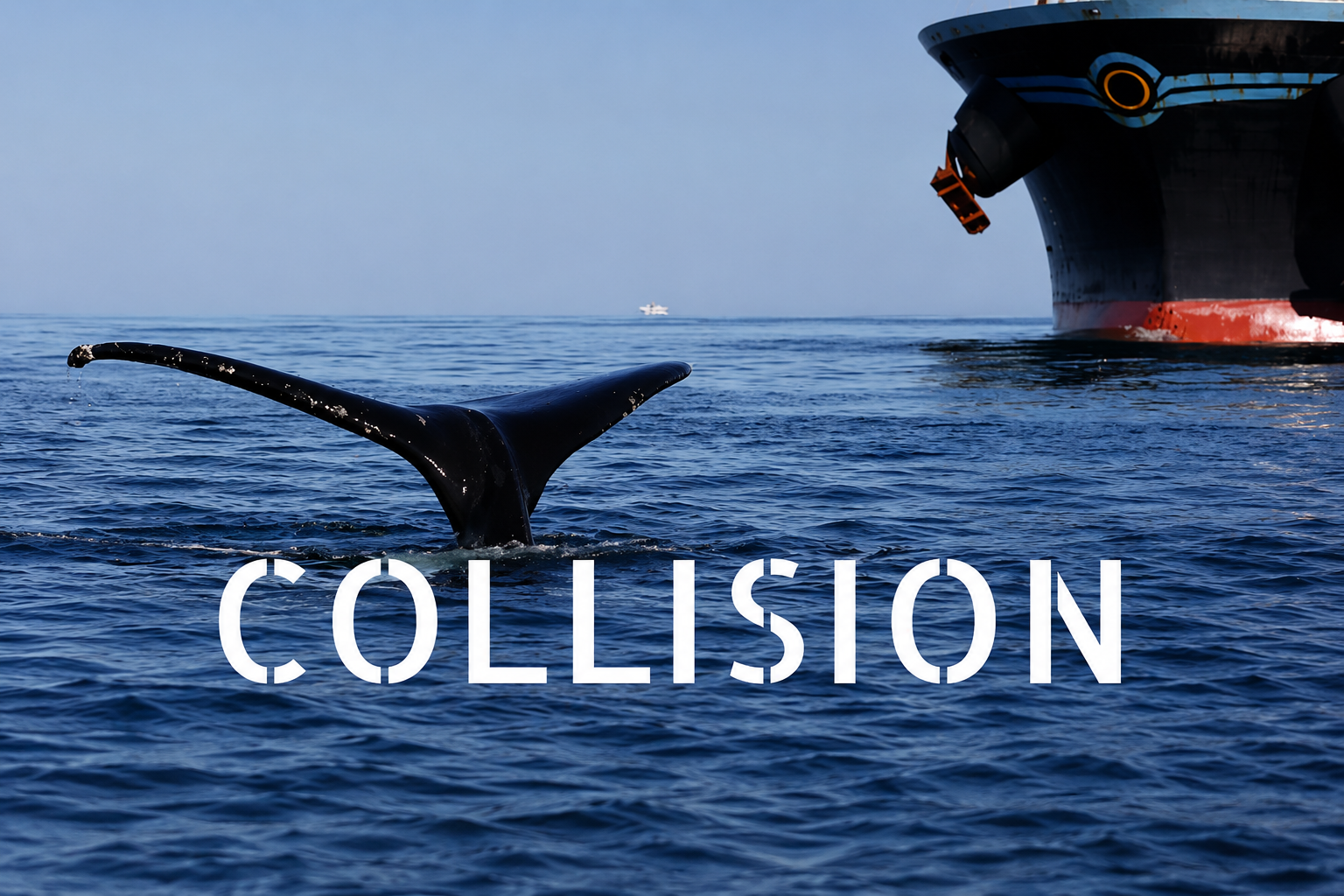
If you drop a hydrophone into the open ocean and listen, you will rarely hear silence. More often you hear engines: the low, carrying drone of a ship you cannot yet see, sometimes an hour before it appears on the horizon. For a whale, that sound is the texture of the modern sea. It is also, increasingly, the last thing many of them hear.
*Collision*, the feature documentary premiering on Ecoflix, is about the largest animals that have ever lived and the largest machines we have ever built, meeting in the same narrow band of water. It is a film about a threat most people never think about, told by the people who cannot stop thinking about it: the marine biologists tagging whales, the ship captains who have come to understand what their vessels do, and, remarkably, the shipping executives now choosing to change course.
## Highways we cannot see
Humans have crossed the oceans for more than ten thousand years, but the scale of what we do now is new. The world's commercial fleet passed 100,000 vessels in 2021. Traffic has quadrupled in two decades. A single ship can carry 24,000 containers, a load that would need a freight train forty-four miles long. There is almost no part of modern life that shipping does not touch, and yet its full weight on the ocean stays invisible to most of us. Seen from a satellite, the sea is laced with what look like motorways, busy at every hour.
Whales evolved across fifty million years without a fast, deadly predator at the surface. Nothing in their long history prepared them for a super-tanker. So when scientists tagged blue whales in shipping lanes, they watched something almost unbearable: even with a ship bearing straight down on them, the whales held their course. There was no recognition, no evasive turn. The reasons are physical as much as behavioural. A ship's engine sits at the stern, casting an acoustic shadow ahead of the bow, so that in the final moments a whale may sense the noise fading just as the danger arrives. Deep-diving species such as beaked, pilot and sperm whales surface like bullets after an hour or more below, and must rest at the top of the water precisely where the hulls are.
The result is a toll that is genuinely hard to count. Estimates of great whales killed by ships each year run from around 9,000 to more than 20,000, and researchers are clear that even the higher figure captures only a fraction of the true number. Ships have grown so large that crews often do not know they have hit anything until a whale is found draped across the bow in harbour. On the best available evidence, we see fewer than five per cent of the whales that die this way. Whales, as one scientist in the film puts it, are becoming the ocean's roadkill.
## A species measured in dozens
Nowhere is the arithmetic starker than off the eastern coast of North America. The North Atlantic right whale is down to roughly 330 animals, of which only about seventy are breeding females. Since 2017 at least thirty-four have died that we know of, close to a tenth of the population. Around 83 per cent of the survivors carry scars from entanglement in fishing gear. These whales no longer die of old age. Where they might once have lived to seventy, they now die on average at thirty-five, killed by a vessel or a rope. Climate change is pushing them into new waters, into the path of fishing fleets and shipping lanes that were never part of their world.
## A problem we know how to solve
Here is the part of *Collision* that refuses despair. Ship strikes are not a mystery. There are two proven levers, and they are almost embarrassingly simple: keep ships and whales apart by re-routing traffic, or slow ships down, ideally to no more than ten knots over the continental shelf. The smallest deviation can protect the places where whales feed and breed. The film travels the world to show both the wins and the warnings.
In Panama, a traffic separation scheme placed through the deepest, least-frequented water of the gulf, combined with a seasonal slowdown, cut strikes by more than ninety per cent. In New Zealand's Hauraki Gulf, scientists, port authorities and local Māori chose not to wait for the slow machinery of formal regulation. Ships voluntarily dropped from around fourteen knots to ten, and after September 2014 the ship-strike deaths simply stopped. Off Sri Lanka, where one of the world's busiest lanes runs straight through blue whale habitat, researchers showed that shifting the route just fifteen miles south would cut the risk to whales by around 95 per cent, at a cost to each vessel of perhaps forty minutes on a voyage of weeks. As the film was being finished, MSC, the world's largest container carrier, began voluntarily re-routing its largest ships to the south and holding them under ten knots, in the hope that the rest of the industry would follow.
The warnings are just as clear. In the Mediterranean, endangered fin whales feed close to the Catalan coast amid some 2,000 near-miss events each summer. In the Hellenic Trench off Greece, a population of sperm whales has been halved to around 150 animals in a decade, because the shipping route runs directly along the depth contour the whales depend on. In the Canary Islands and the fjords of Chilean Patagonia, growing ports and faster ferries are turning rich feeding grounds into danger zones. Voluntary systems only work when ships actually act on them, and too often they have not.
## Who we are, and who they are
What lifts *Collision* above a catalogue of harm is its insistence that this is a choice. The technology to detect whales in real time exists. The legal instruments, from traffic separation schemes to particularly sensitive sea areas, exist. What is needed is the public awareness to give politicians and regulators the mandate to act, and the willingness of an industry to accept a few extra minutes at sea. The film ends not with a body count but with a plea for empathy: to understand these intelligent, social, self-aware animals, and in doing so to understand something about ourselves. There is a cost to the way we move goods around the planet, and at the moment it is the ocean that is paying it.
Time is short. For some of these populations, as one researcher says, this may be the last chance to recover. But the evidence gathered in this film is that when people decide to act, whales stop dying. That is the rarest thing in conservation: a solvable problem.
*Collision* is a Wildlife Media and Ocean Souls Films production, with cinematography by Philip Hamilton. Ecoflix is proud to present the premiere. **Watch now at [watch.ecoflix.com/programs/collision](https://watch.ecoflix.com/programs/collision).**
More in Oceans
Most Marine Protected Areas Exist Only on Paper
On World Oceans Day, the gap that matters most is not between healthy seas and degraded ones — it is between the protections governments have announced and the ones that actually function. The 30x30 target is closer than it looks, and further away than the numbers suggest.
Read featureWhy Humpback Whale Migration Tests Our Relationship With the Sea
Each winter, humpback whales travel from Alaska to Hawai‘i, following one of the Pacific’s most important migration routes. Ocean Guardians explores what that journey reveals about marine conservation and the continuing challenge of living
Read feature
The Land That Came Back to Life
On World Environment Day 2026, the most powerful argument for nature-based climate action is not a projection or a policy paper. It is the evidence of what communities have already done — on three continents, with their own hands and their own land.
Read feature